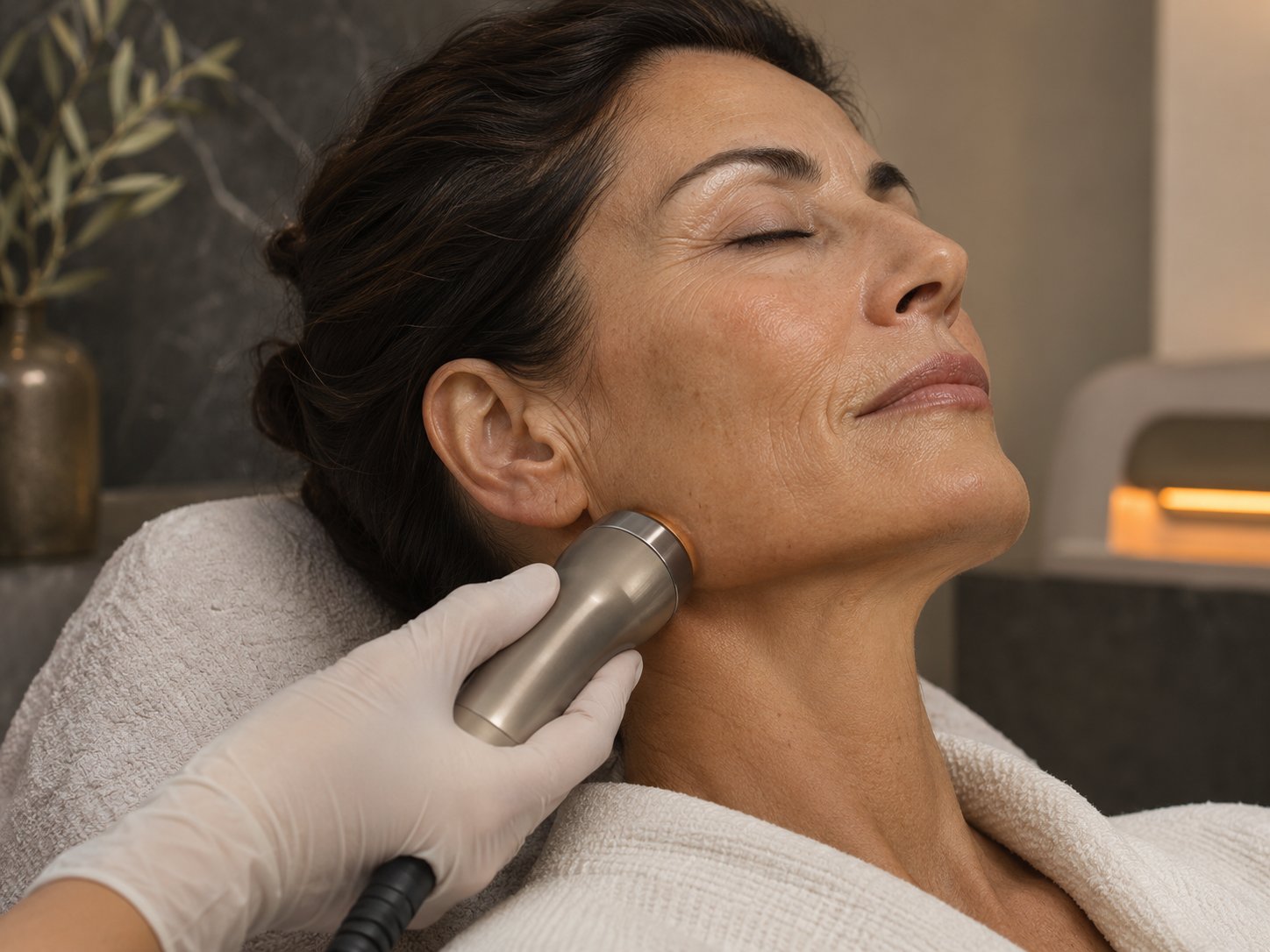
Radiofrequency is not one treatment. Devices differ in how energy reaches tissue, how temperature is monitored and whether needles or muscle stimulation are involved. Those differences matter more than the broad label ‘RF’. Outcomes are usually gradual and modest, and the evidence is not equally strong for every system.
Key takeaways
- Non-invasive RF heats tissue through the skin; RF microneedling delivers energy through inserted needles and has a different risk profile.
- Recent studies are encouraging for selected facial tightening and wrinkle outcomes, but protocols vary and many studies are small or industry-connected.
- RF microneedling is a medical procedure. The FDA has reported serious complications with certain uses, including burns, scarring, fat loss, disfigurement and nerve damage.
First identify the technology family
Non-invasive monopolar, bipolar and multipolar RF devices pass energy through intact skin to generate controlled heat. Designs vary in depth, electrode arrangement, cooling and feedback. Some newer platforms use multiple frequencies or real-time impedance and temperature controls intended to make energy delivery more consistent.
RF microneedling is different: needles enter the skin before RF energy is released. Combination platforms may pair RF with ultrasound, optical energy, vacuum or facial-muscle stimulation. A study of one device does not automatically validate another device with a different energy path and protocol.
What newer facial studies are showing
A recent systematic review of 15 studies found generally favourable results for non-invasive facial RF, while also emphasising heterogeneity in devices, treatment schedules and outcome measures. That makes it difficult to name one ideal protocol or predict the same result for every person.
A 2026 prospective multicentre study of a dual-frequency monopolar RF device enrolled 39 participants and reported improvement using investigator and participant assessments. Another 2026 multicentre randomised non-inferiority trial enrolled 230 participants to compare a newer monopolar RF system with an established device. Larger comparative designs are useful, but device-specific results still need to be interpreted alongside funding, follow-up length, skin-type representation and adverse-event reporting.
Home-use RF has also been studied. One open-label trial included 22 women using a facial device. Small, uncontrolled studies can identify a signal worth investigating, but they cannot establish that all home RF tools are effective or safe.
Set realistic expectations
Non-invasive RF is generally positioned for subtle to moderate improvement in laxity, texture or fine lines rather than a surgical lifting effect. Results may develop over weeks or months and may require a series or maintenance. Individual response depends on age, anatomy, tissue quality, treatment settings and the endpoint being measured.
Before-and-after photographs should use matching light, angle, expression, camera distance and timing. Immediate post-treatment swelling can temporarily change contours and should not be presented as a durable tightening result.
Safety depends on modality, operator and settings
Expected short-term effects for non-invasive RF may include warmth, redness, tenderness or swelling, but burns and pigment changes are possible when energy delivery is inappropriate. Devices used near the eyes, nerves, dental work or implanted metal and electronic devices require specific screening.
In October 2025, the U.S. Food and Drug Administration warned about reports of serious complications associated with certain uses of RF microneedling, including burns, scarring, fat loss, disfigurement and nerve damage. The agency advises choosing a licensed provider trained in the procedure and states that RF microneedling should not be used at home.
Questions worth asking at consultation
Ask for the device manufacturer and model, whether the treatment is non-invasive or needle-based, what the device is authorised for in your region, who will operate it and how that person was trained. Discuss previous procedures, fillers, threads, implants, dental hardware, medicines, pigmentation history and any condition that changes sensation or wound healing.
Request a realistic range of outcomes, the total treatment plan, downtime, maintenance, alternatives and the clinic’s protocol for burns, unexpected fat loss, prolonged pain or nerve symptoms. A careful provider should be comfortable explaining when RF is not the right option.
Sources and further reading
- U.S. Food and Drug Administration Potential Risks with Certain Uses of Radiofrequency Microneedling
- Aesthetic Plastic Surgery Evaluating the Safety and Efficacy of Radiofrequency-Based Treatment for Facial Aesthetics: A Systematic Review
- PubMed Dual-frequency noninvasive monopolar radiofrequency for facial rejuvenation: A prospective multicenter study
- PubMed A multicenter randomized noninferiority trial of a novel monopolar radiofrequency device
- Journal of Cosmetic Dermatology An open-label clinical trial evaluating a home-use radiofrequency device for facial skin